
Every year, thousands of skilled professionals submit EB-1A petitions convinced they’ve checked the right boxes. They have judging experience. They’ve published articles. They hold senior titles at recognizable companies. Some even command salaries that land well above industry benchmarks.
Then they get denied.
Not at the initial evidence stage — at the final merits determination, the second and harder step of USCIS’s two-part extraordinary ability analysis. It’s the stage most petition guides barely mention, and the one that’s ending careers worth of carefully assembled cases.
Five Administrative Appeals Office decisions handed down between February and April 2026 show exactly how this plays out across cybersecurity, site reliability engineering, neuroscience, the arts, and journalism. None of the petitioners were weak candidates on paper. All five appeals were dismissed. Reading the AAO’s reasoning across these decisions is more instructive than any checklist — because the pattern that emerges isn’t about which documents to gather. It’s about how USCIS measures “extraordinary” against a standard most petitioners never fully grasp until it’s too late.
The Two-Step Framework Everyone Misunderstands
Before the cases, the structure matters.
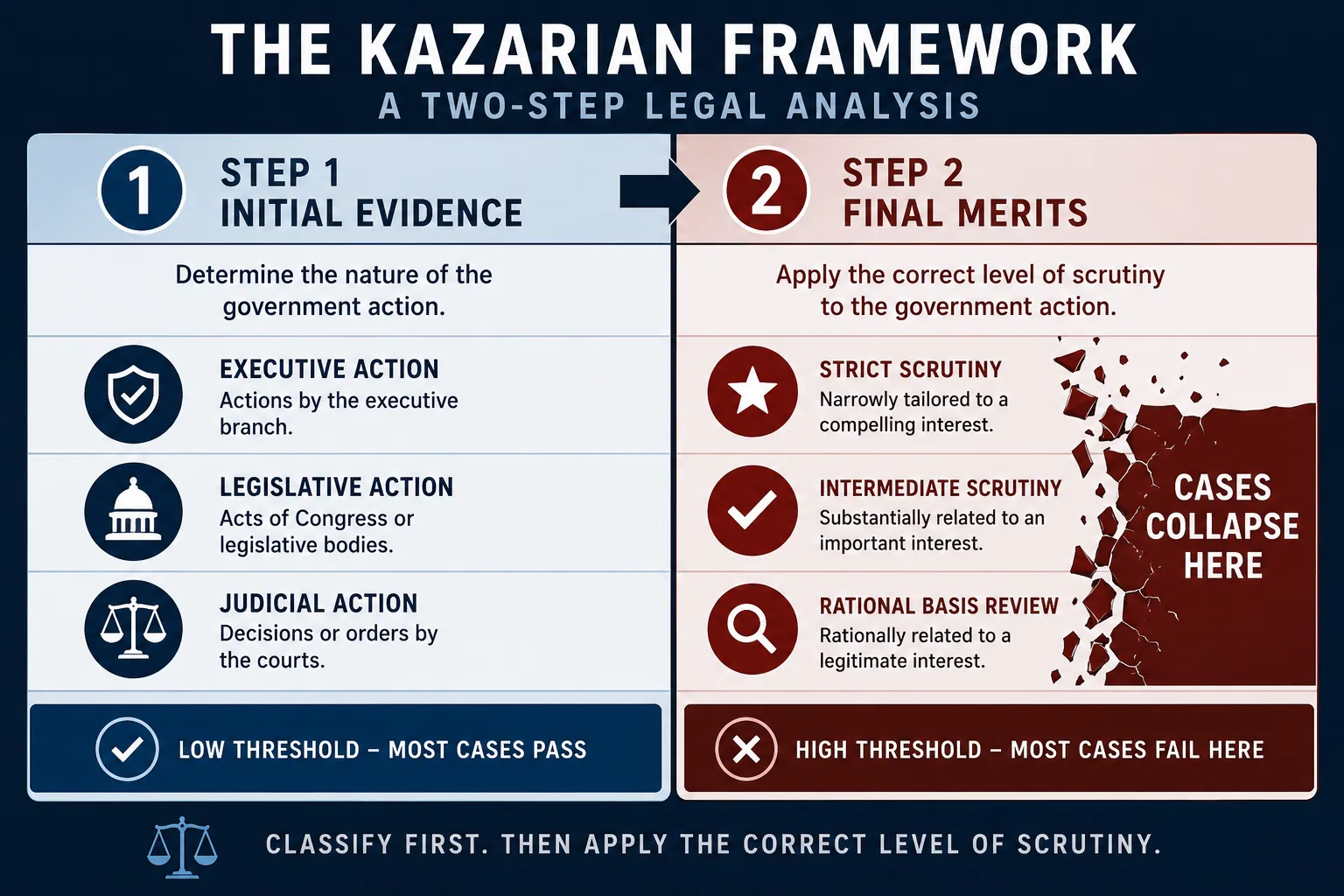
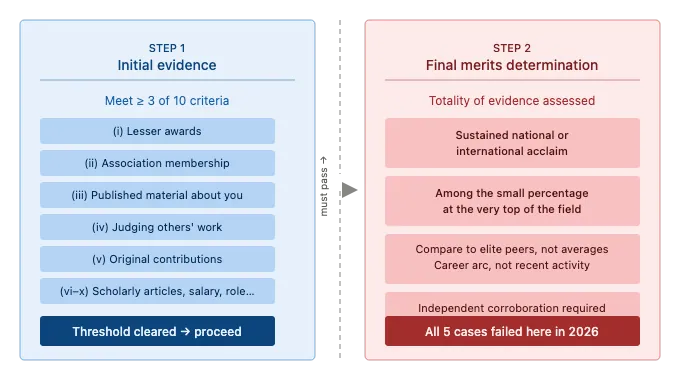
The EB-1A process runs on a two-part Kazarian analysis. In step one, USCIS counts evidence: did the petitioner receive a major internationally recognized award, or do they satisfy at least three of ten regulatory criteria — awards, membership, press coverage, judging, original contributions, scholarly articles, artistic displays, leading role, high salary, commercial success?
Most preparation guides stop there. Meet three criteria, they imply, and the path forward clears.
It doesn’t.
Step two is a final merits determination. The question shifts entirely. USCIS no longer asks whether specific criteria are met. It asks whether the totality of the evidence demonstrates sustained national or international acclaim — and whether the petitioner is among that small percentage who have risen to the very top of the field of endeavor.
Those two phrases carry enormous weight. “Sustained” means consistent over time, not a recent burst of activity. “Small percentage at the very top” means the AAO compares a petitioner not to the average professional in their field but to the most recognized figures in it. Meeting three criteria gets you into the room. Clearing the final merits standard requires filling that room with a different kind of proof entirely.
What these 2026 decisions show is that USCIS adjudicators are applying this second standard with notable precision — and that the most common mistake petitioners make is spending all their energy on step one while leaving step two almost entirely unaddressed.
The Five Cases at a Glance
Before examining each decision in depth, the table below maps the five petitioners, their fields, how many criteria they claimed, how many were ultimately accepted, and the specific reason each appeal failed.
| Case | Field | Criteria Claimed | Criteria Accepted | Why It Failed |
|---|---|---|---|---|
| 40795791 | Cybersecurity / InfoSec | 7 | 3 | Met threshold; failed final merits on all three |
| 40669786 | Site Reliability Engineering | 5 | 0 | SCOPS grants reversed on appeal; never reached final merits |
| 42202352 | Neuroscience / MS Research | 4 | 2 | Failed to establish third criterion; never reached final merits |
| 40766145 | Street Dance / Arts | 4 | 1 | Field mismatch; credentials applied to wrong category |
| 41456310 | Journalism / Creative Arts | 5 | 0 | Evidence quality and procedural failures throughout |
Two of the five cases — cybersecurity and SRE — involve tech professionals whose profiles will look familiar to a large portion of the self-petition audience. They deserve the closest reading.
Case One: The Cybersecurity Executive Who Met Three Criteria and Still Lost
An associate vice president of information security at a well-regarded company filed an EB-1A claiming seven of the ten regulatory criteria. SCOPS found he met two: judging and leading or critical role. The AAO on appeal corrected one error — his high salary also qualified — bringing the total to three.
Three criteria met. Appeal dismissed anyway.
The final merits analysis in this decision reads like a manual of what not to assume about your evidence. The petitioner served on the editorial boards of three journals, reviewed articles for additional publications, and judged entries in an industry competition. These activities satisfied the judging criterion at the initial stage. At final merits, the AAO asked a harder question: do these activities place him among the small percentage at the very top of his field?
The answer was no — and the reasoning is worth studying carefully. Among the other judges of the same competition, the record showed, was a graduate teaching assistant. The presence of a graduate student on the same judging panel as a claimed extraordinary talent is, in the AAO’s reading, evidence that the credential does not distinguish the top of the field from the broader professional population. The petitioner never demonstrated that his review volume was exceptional relative to others at the highest level, never established that the journals were among the most distinguished in cybersecurity, and never showed that his editorial roles attracted wide professional attention.
His publication record presented a similar problem. Fourteen scholarly articles and a co-authored book looked substantial until the AAO noted that both fell entirely within 2024 and 2025 — a two-year span. USCIS frames extraordinary ability as a “career of acclaimed work,” language drawn from congressional committee reports. Two years of publishing, however prolific, does not constitute a career.
His high salary cleared the criterion threshold but stumbled at final merits for a reason that recurs across multiple EB-1A denials: he compared himself to others in similar roles rather than to individuals specifically recognized as being at the very top of the field. USCIS doesn’t want to know that an Associate VP earns more than most Associate VPs. It wants to know whether his compensation is commensurate with the kind of recognition that defines the elite tier of his profession.
The press coverage problem was starker still: one article, in ibtimes.sg, published in 2025. The AAO noted that a single press mention is structurally inconsistent with sustained national or international acclaim, where “sustained” implies a pattern across time.
The case was dismissed.
Case Two: The Site Reliability Engineer Whose Two SCOPS Wins Were Reversed on Appeal
A site reliability engineer and director of SRE at a prominent tech company filed an EB-1A claiming five criteria. SCOPS initially granted him two — judging and leading or critical role. The AAO reversed both on appeal, leaving him with zero qualifying criteria. He never even reached the final merits stage.
This case introduces a failure mode invisible in most petition guides: winning at SCOPS is not the same as winning. The AAO reviews cases de novo — fresh, from the beginning — and is not bound by what the service center accepted.
The judging criterion collapsed first. The petitioner had served as a judge for a competition where high school students developed solutions across aerospace, cyber-technology, energy, health, and water challenges. The USCIS Policy Manual gives examples of qualifying judging experience — peer review and doctoral dissertation committees. Reviewing high school student projects across five unrelated industries didn’t approach that standard, and the petitioner offered no explanation of how it did.
The leading or critical role determination was more instructive because it showed how SRE professionals in particular tend to frame their contributions — and why that framing fails.
The petitioner led a team of 35 engineers at a recognizable company and managed a budget exceeding five million dollars. His letters described him onboarding over 150 enterprise customers and implementing initiatives that saved the company $1.7 million. The AAO accepted none of this as establishing a leading or critical role.
For a leading role, USCIS looks at whether the person is a leader within the overall organization or a distinguished division of it — not simply a manager of a team within it. The petitioner’s org chart showed his team’s composition but not where that team sat in the broader organizational structure. Without that context, “director of SRE” could mean anything from a C-suite adjacent function to a mid-level operational team.
For a critical role, USCIS requires that the person’s contributions be of significant importance to the outcome of the organization’s activities — not just successful execution of assigned work. Saving $1.7 million and onboarding enterprise customers are achievements, but the letters never placed those achievements in the context of what they meant for the company’s overall direction, revenue, or survival. The AAO noted that even if these roles had been established, a leading or critical role for a department or division requires separately establishing that the department or division itself has a distinguished reputation — not just that the overall company does.
On original contributions, the petitioner’s letters described him optimizing processes, deploying new technology, and redesigning infrastructure — without explaining what was original about the work or what impact it had beyond his immediate employer. His claim on appeal that frameworks he built were adopted by other internal teams didn’t help: adoption within a single company’s divisions is not adoption “by the field,” and work that may be proprietary cannot be treated as a contribution to the broader profession.
The membership claim failed on a technicality that could have been avoided entirely. He initially claimed IAENG, whose website states it “welcomes all engineering professions to join” — an open membership that by definition cannot require outstanding achievement. He switched to Sigma XI on RFE, but couldn’t establish when he joined relative to his April 2025 filing date, and his certificate showed associate membership, not full membership. Associate membership in Sigma XI requires only aptitude for research or holding a research job. The full membership standard — noteworthy original investigation — was irrelevant because he never demonstrated he held it.
Appeal dismissed without reaching final merits.
Case Three: The Neuroscience Researcher Whose Letters Said Everything Except What Mattered
A staff research associate with a PhD in biological sciences from an Indian university, postdoctoral work at a major US institution, and a publication record in MS and neurodegeneration research filed an EB-1A claiming original contributions of major significance as one of his core criteria. The petition included more than fifteen recommendation letters from professors and pharmaceutical scientists across multiple countries.
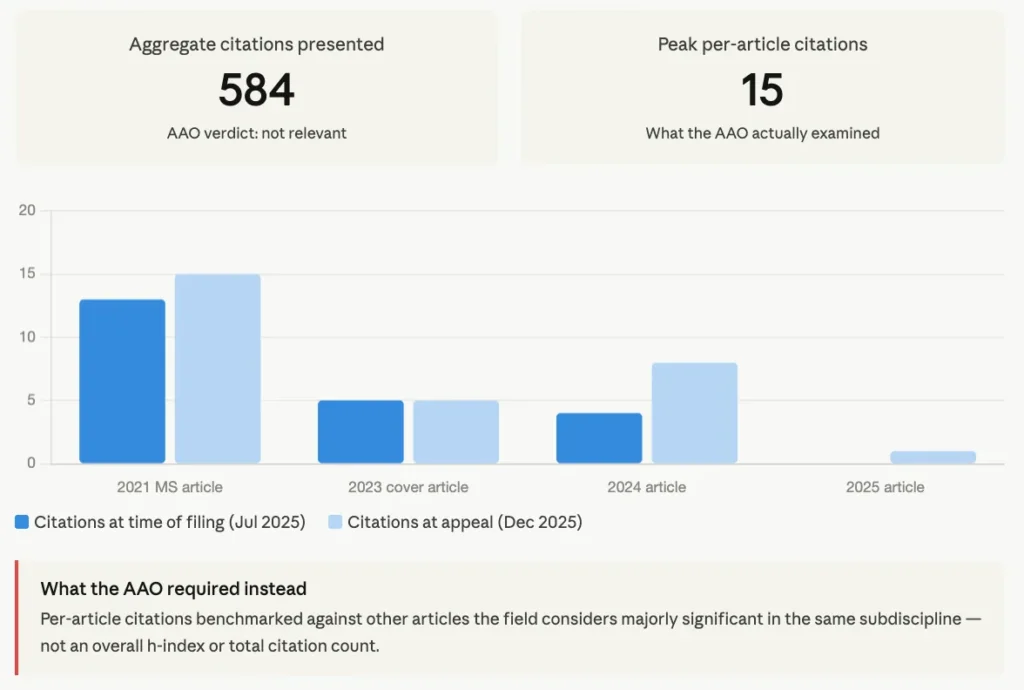
He had 584 aggregate citations. He held a US patent on an Alzheimer’s animal model. One of his research images appeared on the cover of a major journal. His institution issued a news release about his findings. He submitted data to the NIH Gene Expression Omnibus.
USCIS found he met two criteria — judging and scholarly articles. He needed a third. Original contributions of major significance was denied at the initial stage and the AAO upheld that denial on appeal.
The citation analysis in this decision is the most detailed treatment of citation evidence in recent AAO jurisprudence and deserves close attention from anyone in academic science.
The AAO did not dispute that his work received citations. It rejected the way citations were presented. The petitioner led with his aggregate total — 584 at filing, 628 by December 2025. The AAO held that aggregate citation figures reflect an overall publication record and do not identify which specific contributions the field considers majorly significant. Since he was claiming significance for particular articles published between 2021 and 2025, what mattered was the citation count for those individual articles — which ranged from zero to fifteen.
Fifteen citations to a 2021 article. Four to a 2024 article. Five to the article whose image appeared on the journal cover. The cover feature itself was dismissed because the petitioner provided no independent documentation from the publisher establishing that cover selection signals scientific distinction. His assertion that cover images are reserved for extraordinary work carried no weight without external corroboration from the journal itself.
The institutional news release suffered the same problem from a different angle. It came from the same institution that produced the research. The AAO draws a consistent distinction between coverage that originates externally — third parties engaging with work because they find it significant — and institutional communications that are by definition self-referential.
The patent on the Alzheimer’s animal model had one external citation. One.
Fifteen expert letters described the petitioner’s work in technical detail, praised its novelty, and asserted major significance. The AAO read each one carefully and found the same structural gap across nearly all of them: they explained what the research does, then declared it significant, without demonstrating how that significance had manifested in adoption, widespread commentary, or field-level impact. Several letters speculated about future influence — therapies that might be developed, frameworks that could shape the field. The AAO treats future potential as categorically different from present demonstrated impact.
The line the AAO drew is precise: a letter that describes novelty and asserts significance is not the same as a letter that documents what other researchers have done differently because of this work.
Appeal dismissed without reaching final merits.
Case Four: When Your Credentials Apply to the Wrong Category
A street dance competitor with medals, association appointments, and recognition across Chinese dance organizations sought EB-1A classification — not to continue competing, but to expand his work as a director of a street dance education company, hosting workshops, institutionalizing street dance education in the US, and fostering cultural exchange.
The petition encountered a problem none of his awards could fix: the area of extraordinary ability he demonstrated was competitive street dancing. The work he intended to do in the United States was street dance education and cultural development.
USCIS and the AAO both held that these are not the same area of expertise, applying a standard established in Lee v. Ziglar: a baseball player’s extraordinary ability does not automatically extend to managing or coaching. The court held it is reasonable to interpret “continuing to work in one’s area of extraordinary ability” as working in the same profession, not any profession in the same field.
Every credential he held — the competition medals, the association positions — was evaluated under the educator category, where it didn’t apply. His claimed leading or critical role was based on founding and running his company, but the record couldn’t establish the company’s size, funding, longevity, customer base, or standing relative to similar organizations. The employment confirmation letter closing with “Sincerely” and the company name, without identifying its author, was given limited probative weight.
The case illustrates a transition problem that appears frequently among EB-1A filers: professionals who built genuine recognition in one role and now operate in a related but distinct capacity. Entrepreneurs who were previously researchers. Former academics now running consulting practices. Performers who have moved into production, direction, or education. In each situation, the credentials must align with the intended US work — and when they don’t, even a strong evidentiary record fails at the threshold.
Appeal dismissed.
Case Five: Why Evidence Timing Is Permanent
A journalist and poet from Kazakhstan filed an EB-1A claiming eligibility under multiple criteria. The petition included finalist certificates from literary competitions in Kazakhstan and Uzbekistan, documents showing affiliation with a cultural organization and a church, and a blog post about Christmas submitted as a scholarly article.
USCIS denied each criterion. Finalist certificates are not awards or prizes within the meaning of the regulation. The affiliated organizations didn’t require outstanding achievements of their members. A blog post does not constitute a scholarly article in a professional or major trade publication.
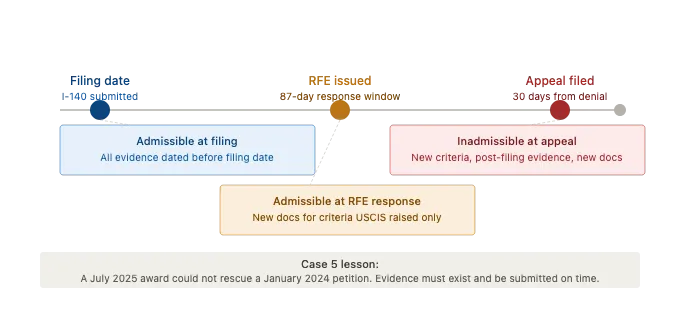
On appeal, the petitioner raised three criteria she hadn’t argued below — judging, original contributions, and display of work. She submitted new documents including a certificate of commendation from 1999 and an award she received in July 2025.
The AAO declined to consider any of it.
The procedural rules are unambiguous. An appeal exists to correct errors the adjudicator made in the prior proceeding — not to introduce new arguments or submit evidence that wasn’t part of the original record. Criteria not raised before USCIS cannot be raised for the first time on appeal. Evidence that existed before filing but wasn’t submitted, despite the petitioner having received an RFE and thus adequate notice to provide it, cannot be introduced at the appeal stage. Evidence acquired after the filing date is excluded regardless of its quality, because eligibility must be established as of the time of filing.
The July 2025 award, whatever its merit, was irrelevant to a petition filed in January 2024.
This case is the starkest illustration in this set of a principle that governs every EB-1A filing: the petition you submit — including how you argue it and what you include — is largely the record you have for the life of the case. An RFE is not a retry. An appeal is not a second chance to rebuild the evidentiary foundation.
Appeal dismissed.
The Pattern Across All Five: What the Final Merits Standard Is Actually Testing
Reading these five decisions together, the AAO’s methodology becomes clear in a way it rarely is from any single case. Six recurring failure patterns account for virtually every dismissal in this set.
Comparison to the very top, not to the average. In every science and tech case, the petitioner compared themselves favorably to other professionals in their field — other VPs, other SRE directors, other researchers. The final merits standard requires comparison to the most recognized figures at the highest tier. A high salary relative to all Associate VPs is a different claim than a salary commensurate with sustained national acclaim in information security.
Corroboration must come from outside. Recommendation letters, employer statements, and institutional press releases all carry diminished weight because their authors have a relationship with the petitioner. The AAO consistently looks for third-party engagement — citations from researchers with no connection to the petitioner, press coverage from outlets with no institutional stake, awards selected by judges with no prior relationship. In Case 3, fifteen expert letters still weren’t enough because none of them provided independent, external evidence of impact.
Internal adoption is not field adoption. The SRE engineer’s frameworks adopted by other teams within his own company, the neuroscience researcher’s institutional news release, the cybersecurity executive’s employer-validated achievements — all were discounted because they demonstrated value within a closed system rather than recognition from the broader field. Extraordinary ability is measured by how the field at large responds to your work, not by how your employer rewards it.
Sustained means demonstrated across time. Two years of publications, a single press mention, a recent burst of judging activity — none of these satisfy “sustained” national or international acclaim. The word implies a track record, not a recent achievement. Filing while your record is still accumulating is one of the most common timing errors in EB-1A petitions.
Significance must be evidenced, not asserted. Across Cases 2, 3, and 4 in particular, the AAO draws a clear line between claiming significance and documenting it. Expert letters claiming groundbreaking impact carry less weight than independent citations from researchers who adopted a specific methodology without prompting. Describing novelty is not the same as demonstrating adoption.
Process errors are permanent. New arguments cannot be raised on appeal. Evidence not submitted during the initial proceeding or in response to an RFE does not become available later. Achievements after the filing date don’t count. The SRE engineer’s Sigma XI membership lacked a clear join date. The journalist’s July 2025 award couldn’t retroactively strengthen a January 2024 petition. Both errors were avoidable with better pre-filing preparation.
A Diagnostic Checklist Before You File
The five cases above point toward a practical pre-filing audit that addresses both the initial evidence stage and the final merits standard simultaneously.
| Question | What a Yes Requires |
|---|---|
| Can you name five individuals widely recognized as being at the very top of your field? | Named peers at the apex level, not just senior professionals |
| Does your evidence compare you to those specific individuals — not to average practitioners? | Explicit benchmarking against the field’s elite, not industry-wide salary data or citation averages |
| Is every piece of third-party coverage genuinely independent? | No employer statements, no institutional press releases, no letters from collaborators |
| Does your publication or contribution record span multiple years? | A career arc, not a recent sprint |
| For each expert letter, can you point to one sentence that describes how others have already acted differently because of your work? | Documented adoption, not predicted future impact |
| If you’re transitioning between roles, are your credentials in the intended US work category — not a prior one? | Medals as a competitor don’t establish excellence as an educator |
| Is every document you’re relying on dated before your filing date and submitted before any RFE deadline? | Evidence timeline audit before submission |
What This Means If You’re Preparing a Petition Now
The most practical takeaway from these five cases isn’t about which criterion to pursue. It’s about how to build a record that answers the final merits question from the first page of the petition forward.
Every piece of evidence should do two things: demonstrate that it satisfies the regulatory criterion it’s submitted for, and simultaneously speak to sustained national or international acclaim at the very top of the field. A judging role should come with documentation showing how the judging panel compares to others who judge at the highest level in that specific subdiscipline. A publication should come with a citation analysis comparing it not to the petitioner’s overall citation count but to citation rates for articles considered significant in that particular domain. A high salary should be benchmarked not against all professionals in the role but against individuals specifically recognized as among the elite of the field.
The SRE engineer’s $1.7 million in savings was real. The neuroscience researcher’s fifteen expert letters were genuine. The cybersecurity executive’s editorial board memberships were legitimate. None of it was framed to answer the question the AAO was actually asking.
That question is, in effect: does this person’s overall record look like someone who has already arrived at the top — not someone on their way there?
The five cases dismissed in early 2026 don’t answer it the way USCIS needed them to. Understanding why is the starting point for building a petition that does. Need a helping hand for your self petition? Green Card For Alien can help. Start with a free profile review.