
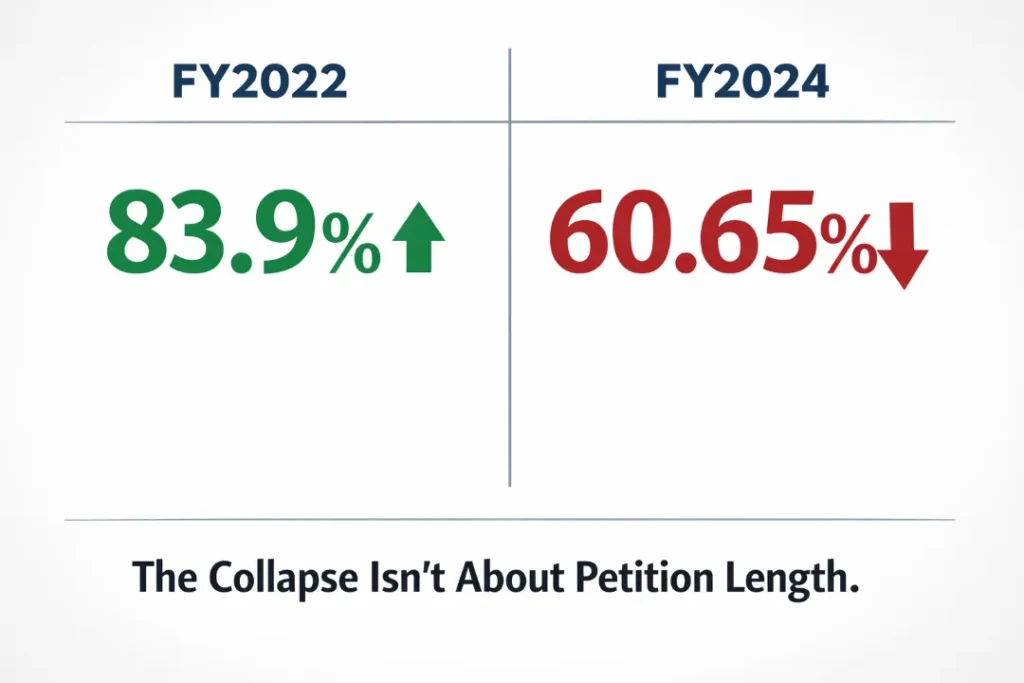
You’ve heard it whispered in forums. You’ve seen it splashed across Reddit threads. And you probably believed it—because so many smart people repeat it. But the length of your EB-1A petition is not why you’re getting denied, although some attorneys still insist that your recommendation letter shouldn’t be more than two pages. In fact, the real killers behind the collapse of EB-1A approvals from 83.9% in FY2022 to 60.65% in FY2024 have nothing to do with pages or word counts. They have everything to do with a fundamental shift in how USCIS adjudicates these cases—and what you can actually control right now. We have acceptances for petitions that were 7000 words and 15000 words. Some were even 25000 words. The length doesn’t matter. Your merit matters, and ofcourse the final impression of the adjudicator – more on that later.
The Numbers Tell the Real Story
Let’s start with what USCIS data actually shows. The approval rate plummeted from 83.9% in 2022 to 60.65% in FY2024—a stunning 23-point drop. In Q3 of 2025, the eb1a approval rate has inched up to 66.6%. But here’s what’s crucial: USCIS documentation have never, ever listed petition length as a primary denial reason. Not once. Not in any official guidance. Yet this myth persists like a virus, causing people to strip down legitimate evidence, weaken their cases, and shoot themselves in the foot.
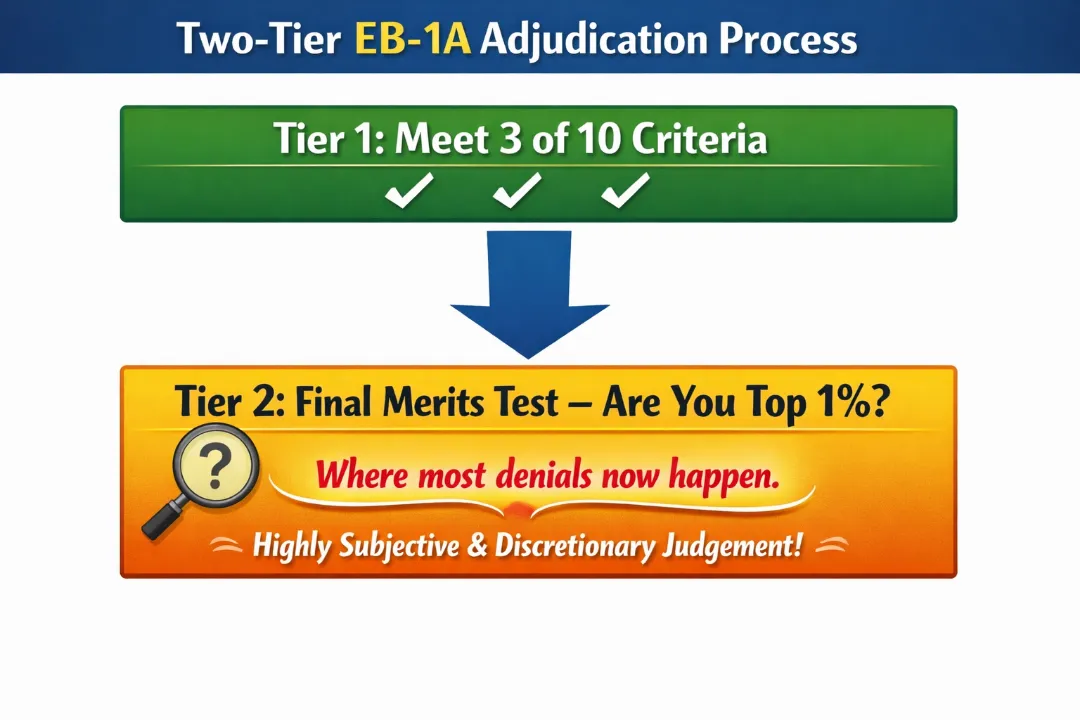
What is listed as the primary driver? The final merits determination—that second-tier evaluation where USCIS officers look at your entire package and decide: are you truly in the top 1% of your field, or just in the top 50%?.
Here’s the psychology at work: We love simple explanations. “My petition is too long” feels more concrete, more fixable, than “I need to demonstrate top-tier status through quantifiable impact metrics.” Cognitive ease bias makes the wrong answer feel right. But that’s exactly when you need to pause and fact-check—especially with something this consequential.
Why Denials Are Actually Skyrocketing: The Real Top 6 Reasons
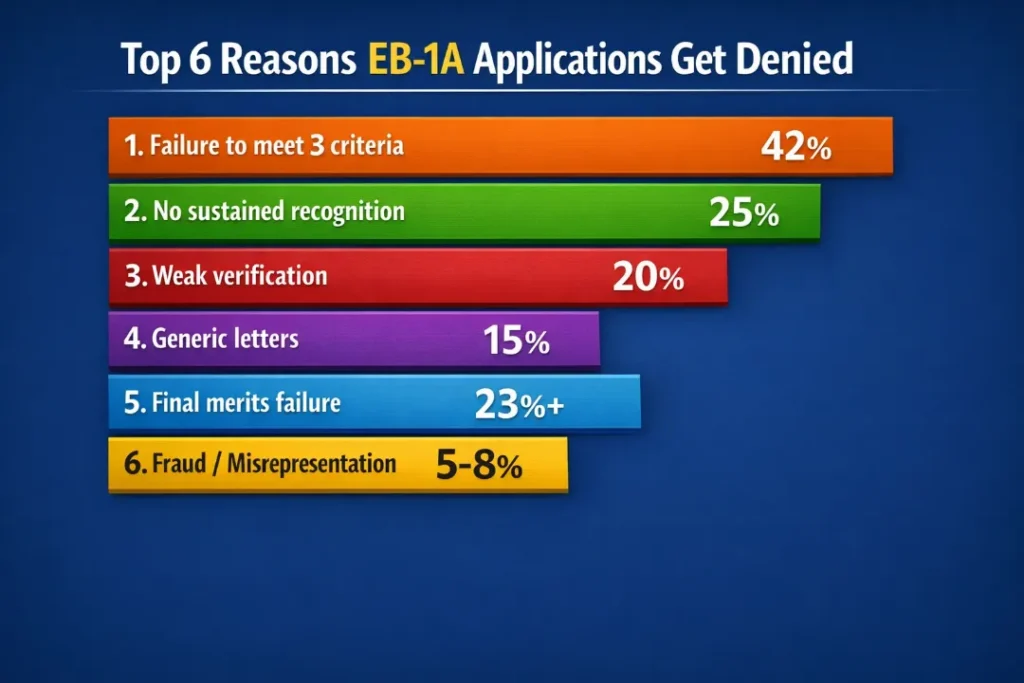
Forget petition length. These are the documented culprits for EB1A denials:
1. Failure to meet minimum three regulatory criteria (42% of denials)
The most common fatal error. Applicants submit weak or insufficient evidence across the 10 criteria—major awards, published material in major media, membership in prestigious associations, high salary relative to field. USCIS now demands specificity. A generic line about your accomplishments won’t cut it anymore.
2. Failure to prove sustained national or international recognition (25% of denials)
You had a moment of glory five years ago. That’s not sustained acclaim. USCIS needs to see ongoing, consistent recognition over time. Isolated achievements—even impressive ones—won’t move the needle at the final merits stage.
3. Insufficient independent verification (20% of denials)
Letters written by you (ghostwritten by a consultant), obscure self-generated content, unverifiable citations—these are red flags. USCIS now cross-references claims against Google Scholar, academic databases, and news archives. This is where the fraud crackdown hits hardest.
4. Weak or vague recommendation letters (15% of denials)
A letter that just says “they’re amazing” gets you nowhere. USCIS wants specific examples, metrics, and explicit connections to the 10 criteria. Generic statements repeated across multiple letters? Officers spot that pattern immediately.
5. Failure on final merits determination (23%+ of denials)
Even if you hit three criteria, you lose. Why? Because USCIS now applies aggressive discretionary judgment. Meeting the mechanical threshold is just the entry fee. The real question—whether you’re top 1%—requires demonstrable, quantifiable impact.
6. Fraud or material misrepresentation (5-8% of estimated denials)
Fabricated publications, fake awards, altered letters, false achievement claims. The crackdown is real, and it’s hitting applicants from all backgrounds—but the concentration of documented fraud involves Indian nationals.
The Fraud Crisis That’s Raising Scrutiny for Everyone
Here’s where the country-of-origin dynamic enters. More than 143,000 Indian nationals with approved EB-1 petitions are waiting for visa availability. This backlog creates what economists call “perverse incentive”: some applicants fabricate credentials to jump the queue. And USCIS has noticed.
The Financial Express reported USCIS cracking down on applicants who published in predatory journals, generated fake citations through coordinated co-authorship networks, and claimed dubious awards like the Stevie and Globee. Networks of roughly 200 individuals, according to one source, collaborated to artificially boost credentials—some offering these tactics as paid services.
The result? Heightened scrutiny across all EB-1A applicants, particularly those from India. Data shows India represents 17.2% of FY2025 Q2 approvals (813 approvals), second only to China at 19.3%. But Indian applicants face approximately 6 percentage points lower approval rates (62% vs 68% overall)—not because of religion or ethnic bias per se, but because of documented fraud concentration.
This is important to understand for a reason: If you’re a genuine applicant with legitimate qualifications, the scrutiny actually benefits you. The USCIS is now separating signal from noise more aggressively. That means stronger evidence wins bigger.
The CARRP Question: Does It Apply to EB-1A?
You might have read about CARRP—the Controlled Application Review and Resolution Program—which subjects certain applicants to indefinite delays without explanation. Here’s the critical distinction: CARRP applies primarily to naturalization (green card holders becoming citizens), not EB-1A employment-based petitions.
Research from St. Mary’s University found that applicants from Muslim-majority countries are routed into CARRP at 10-12 times the rate of others. But this doesn’t directly suppress EB-1A approvals for Muslim applicants—it creates delays after approval, in the citizenship conversion process.
For EB-1A specifically, the data distinguishes by country of origin (India, China, Brazil) rather than religion. And the heightened scrutiny of Indian applicants tracks to fraud prevalence, not religious discrimination. If Pakistani or Iranian Muslim applicants experience delays, those would fall under CARRP-type administrative delays rather than EB-1A-specific rejection.
The practical takeaway: Prepare an ironclad petition with independent, verifiable evidence. Don’t rely on letters, don’t fabricate achievements, don’t publish in predatory journals. The clean applicants—regardless of origin—are winning at higher rates.
What’s Actually Driving the Approval Collapse: The Merits Tsunami
The real story is simpler and scarier: USCIS has shifted from mechanical criteria-checking to aggressive final merits evaluation.
Under the old model, if you hit three criteria, you got approved. Now? Officers are trained to look at totality of evidence and ask: Does this person truly belong in the top 1% of their field?. That second layer of discretion—the final merits test—is where most denials now happen.
And here’s the rub: There’s no bright-line test for “top 1%.” It’s subjective. One officer might approve; another denies the same file. This ambiguity is both a threat (arbitrary outcomes) and an opportunity (excellent preparation can overcome skepticism).
The RFE and NOID waves are accelerating too. In 2025, practitioners report more RFEs and Notices of Intent to Deny than ever, particularly in tech and research fields. USCIS is asking for deeper, more granular evidence of impact—adoption rates, commercialization metrics, third-party corroboration.
The Processing Reality Check: Premium Processing Is Your Insurance Policy
Here’s where actionable intelligence meets scarcity psychology. EB-1A backlog hit 16,000+ cases in 2025. Regular processing now takes 6-12 months, and if you receive an RFE (increasingly likely), the clock pauses.
Premium processing costs $2,805 and guarantees a decision in 15 calendar days. That’s not just faster—it’s certainty. In a climate where adjudication is tightening, knowing your answer in 15 days vs. waiting 12+ months changes your entire strategy.
Why? Because if you get an RFE under premium processing, you can respond quickly. The clock isn’t running while USCIS sits on your file. For Indian applicants especially, where visa backlogs add another layer of waiting, getting your I-140 decision fast is invaluable.
How to Build an EB-1A Petition That Actually Wins (The Playbook)
Stop counting pages. Start counting evidence quality. Here’s the step-by-step approach that’s working:
1. Selection Over Volume: Choose 4-6 Recommendation Letters Maximum
Each letter must address specific regulatory criteria with quantifiable metrics. If you have 15 letters saying “you’re amazing,” officers will see through the padding in seconds. Instead, identify 4-6 recognized experts in your field—people with real authority and reputation—and have each one write a detailed, example-rich letter that connects directly to one or two EB-1A criteria.
2. Emphasize Measurable Impact at the Final Merits Stage
Don’t just prove you meet three criteria; demonstrate you’re in the top 1% through objective metrics:
- Citation counts and h-index scores
- Revenue generated or user adoption rates
- Patents filed and commercialized
- Industry ranking or peer recognition
- Media coverage from mainstream sources (not trade pubs from journals you’ve never heard of)
3. Use Independent Verification—Always
Cite Google Scholar profiles, mainstream media coverage, peer-reviewed databases. Don’t rely solely on letters and self-generated documents. USCIS cross-references, and when they find discrepancies, your entire case weakens.
4. Petition Structure: 20-25 Pages Is Standard and Appropriate
This is critical: there is no USCIS guidance saying shorter is better. Standard petition letters run 20-25 pages—because that’s what it takes to connect evidence to criteria in a compelling way. Shorter isn’t smarter; it’s just less persuasive. Prioritize clarity and explicit connection between evidence and criteria over artificial brevity.
5. Prepare for the Final Merits Conversation Early
Structure your entire argument around demonstrating sustained acclaim and recognition at the national/international level—not just the mechanical three criteria. Use your cover letter to tell the story of why you’re top 1%, not just that you meet three boxes.
6. Anticipate RFEs Proactively
In 2025, RFEs are standard, not exceptional. Build your petition with supplemental documentation ready to go—additional evidence that could address common challenges. If USCIS asks for it, you have it. That saves weeks of delay.
What Green Card For Alien Brings to Genuinely Qualified Applicants
We won’t build your profile for you—that’s on you, and it should be. But here’s where we help: If you have the necessary qualifications, our journalist-led content writing team helps you express yourself better.
Think of it this way. You’re a brilliant researcher, engineer, or entrepreneur. But translating your achievements into the specific language USCIS needs to understand your top-1% status is a different skill entirely. We’ve helped genuine applicants—those who already meet extraordinary ability standards—craft petition narratives, recommendation letter talking points, and evidence summaries that cut through the noise and make officers see what they’re looking at.
Our success isn’t in creating false narratives; it’s in making true ones compelling. And the data shows it works. When applicants work with experienced representation, approval rates climb significantly above baseline.
The Takeaway: Quality Over Everything
The approval collapse from 83.9% to 60.65% is real and dramatic. But it’s not caused by petition length, recommendation letter length, or systemic religious/ethnic discrimination. It’s caused by:
- Tighter final merits standards under subjective officer discretion
- Documented fraud originating largely from Indian applicants, triggering heightened scrutiny
- Political climate shifts toward more restrictive employment-based immigration
- RFE/NOID waves creating processing backlogs
Here’s what you control:
- The quality of your evidence (independent, verifiable, quantifiable)
- The clarity of your petition narrative (explicit connections between evidence and criteria)
- The strength of your recommenders (recognized experts with real authority)
- Whether you use premium processing (certainty in a chaotic landscape)
- Whether you get expert help in translating your achievements into USCIS language
Forget the petition length myth. Build a bulletproof case with strong, independent evidence. Show sustained acclaim. Demonstrate top-1% status through metrics, not just letters. And if you’re a genuinely qualified applicant, work with someone who can help you express yourself better—someone who knows how USCIS reads petitions and what makes officers approve them.
That’s how you buck the trend.