
1. The Hook: The “Invisible Wall” of Technical Success
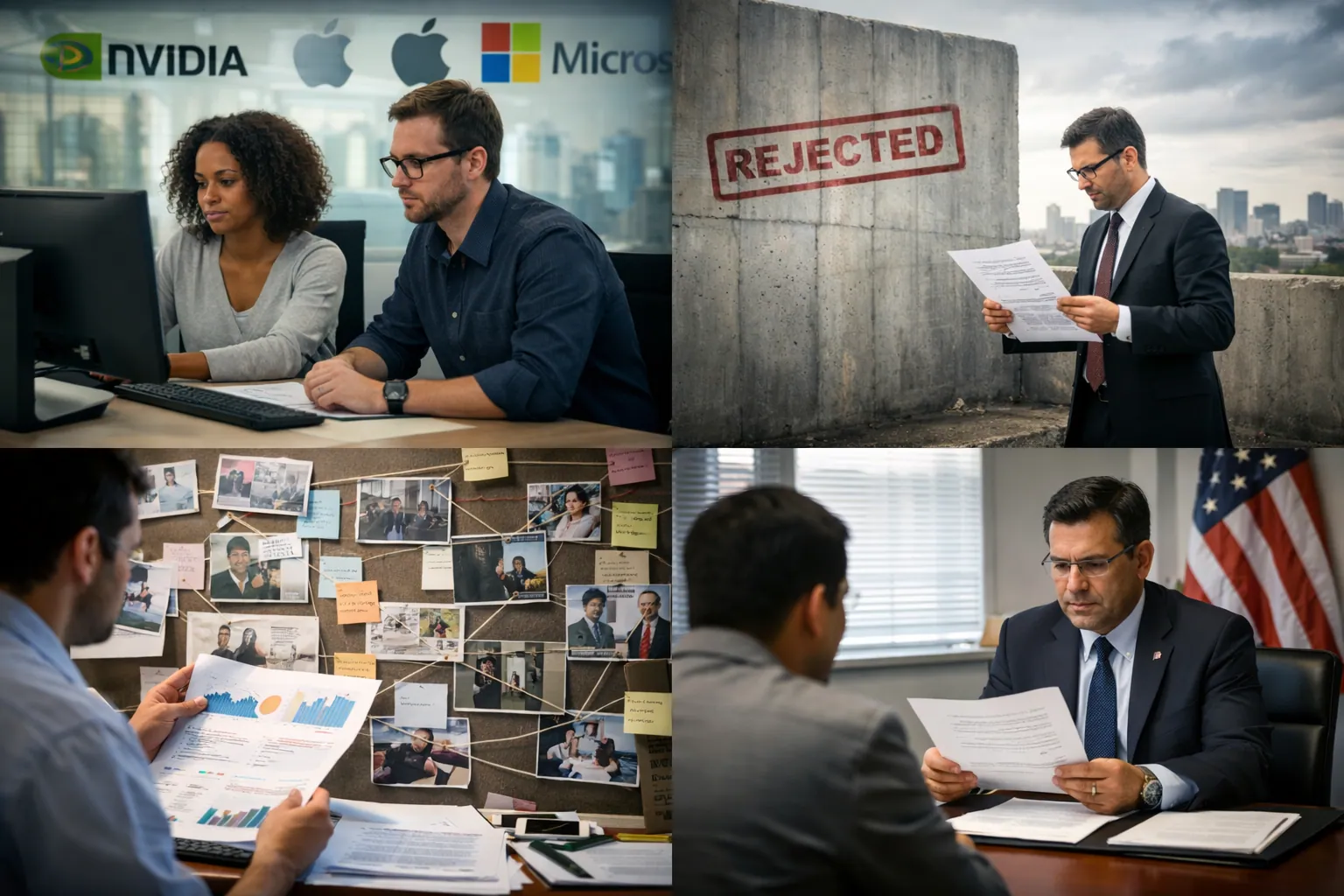
For elite professionals at world-leading organizations—from NVIDIA and Apple to Google and Microsoft—technical brilliance feels like a guaranteed ticket to the American Dream. Yet, many encounter a sudden, jarring halt: the “invisible wall” of the self-petition. Why do world-class scientists and engineers face rejection while peers with identical credentials glide through? The disparity rarely stems from the quality of the work itself; it lies in the translation. Success in the EB1A or EB2-NIW categories requires more than a data dump; it demands a shift from technical reporting to strategic storytelling. To scale this wall, you must transform a career’s worth of achievements into a narrative that speaks the specific, nuanced language of United States Citizenship and Immigration Services (USCIS).

2. Your Technical Expertise Might Be Your Writing’s Greatest Weakness
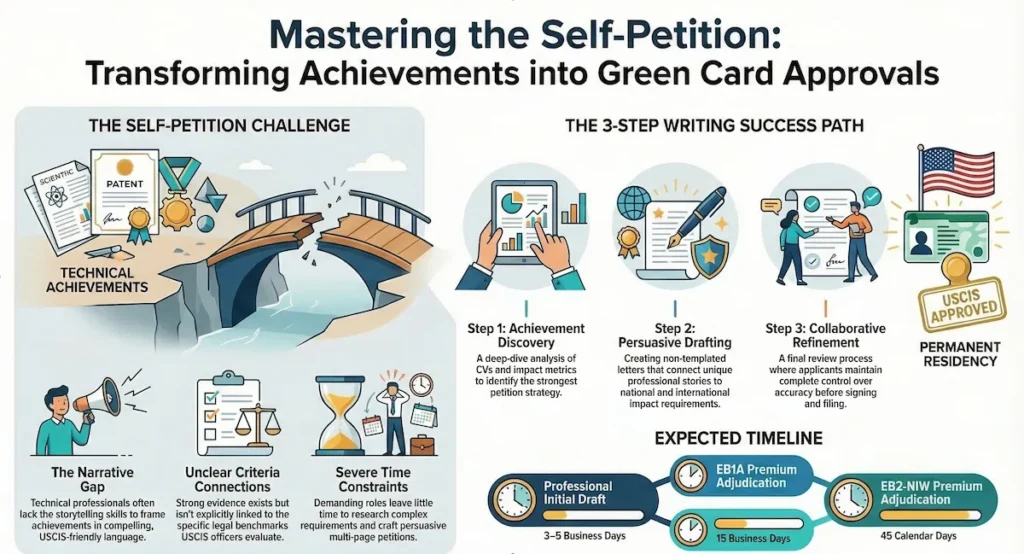
The irony is sharp: the very expertise that defines your career often sabotages your petition. Technical professionals naturally communicate in dense jargon and complex data—languages optimized for peers, not USCIS adjudicators. Generic, self-written petitions fail because they lack the narrative architecture to frame high-level achievements for a non-expert audience.
This gap necessitates journalistic investigative techniques. By applying the rigor of professional reporting, strategists bridge the divide between technical silos and legal criteria. Mapping a career to federal standards is a specialized discipline, distinct from the work itself. Without a narrative that connects the dots, even groundbreaking evidence remains trapped in a vacuum, failing to explicitly satisfy the criteria USCIS evaluates.
3. The “Forgotten Accomplishments” – You’re More Qualified Than You Think
Most applicants view their professional history through a narrow lens, focusing only on recent milestones or major titles. In reality, a significant portion—often nearly a third—of the most impactful evidence remains hidden due to “expert blindness.” This phenomenon occurs when daily excellence becomes so routine to the professional that they lose sight of its “extraordinary” nature in a legal context.
A successful petition begins with a Discovery phase: a deep-dive analysis used to extract accomplishments the applicant may have overlooked or deemed mundane. This process involves researching field-specific impact metrics and benchmarks to provide a baseline for “extraordinary” status. As SR Reddy, a Senior Scientist in embedded systems, observed: “They even researched my work to find accomplishments I had forgotten about! This made my cover letter much stronger.” By analyzing a profile against USCIS precedents, we uncover the hidden proof of excellence required to solidify a case.
4. The “No Degree” Path to Extraordinary Ability
A pervasive misconception suggests that an advanced degree is a non-negotiable requirement for a self-petitioned Green Card. While an advanced degree serves as a standard benchmark for EB2-NIW, the EB1A category offers a potent alternative for those who command international influence, regardless of their formal education.
Success in these instances relies on “national or international impact framing.” Ajay Gupta, a Software Engineer, proved this by securing an approval despite lacking an advanced degree. “I had no advanced degree but proved my work benefits users worldwide. I also showed I earn a rare salary,” he noted. When a petition demonstrates global benefit and exceptional economic value, traditional academic credentials become secondary to the applicant’s proven, real-world impact.
5. Why a Lawyer’s “No” Isn’t Always the Final Word
Discouraging assessments from legal counsel often stem from a reliance on rigid templates rather than deep-dive investigative writing. High-volume practices frequently overlook complex or non-traditional profiles because they lack the time to engage in the necessary research.
A negative initial outlook can be reversed by shifting from a checklist-based evaluation to a merit-based strategy. Building a “water-tight” case requires digging for evidence that standard reviews miss—such as press reviews, concert tickets, or specialized recommendation letters that provide essential context. Manasa N, an Indian Classical Dancer, experienced this shift firsthand. “When I consulted lawyers, they said I had a low chance of success,” she recalls. By moving beyond a template and building a robust, evidence-heavy narrative, she transformed her “low-chance” profile into an approved reality.
6. The “Rarest of Rare” Framework – Defining National Asset Status
The final strategic shift involves moving the focus from “what you did” to “why you are a national asset.” USCIS adjudicators seek the “rarest of rare” talent—individuals whose presence specifically benefits the United States.
Proving this status requires contextualizing achievements with information found even “outside academia,” such as real-world industry impact and public recognition. System Software Engineer Mahesh Patil credits this framework for his EB1A approval, noting that the petition “convinced immigration officials I am a ‘rarest of rare’ talent… an asset to the U.S.” By framing your work as a unique national resource, the narrative provide the “why” that adjudicators need to justify a waiver of traditional employer sponsorship.
Conclusion: Your Story is the Key
Winning an EB1A or EB2-NIW Green Card is ultimately a journey of meticulous translation. It is the process of turning a complex professional history into a compelling legal argument that satisfies federal standards. This transformation is achieved through a collaborative process—pairing your evidence with a professional drafting team that delivers submission-ready packages in just 3–5 business days.
Success hinges not on the sheer volume of a CV, but on the narrative’s power to prove your value to the U.S. national interest. If you looked at your career through the eyes of a storyteller rather than a technician, what “extraordinary” impact would you finally see? Identifying that story is the first step toward the American dream.
Unsure where you stand? Get a free profile check now.