
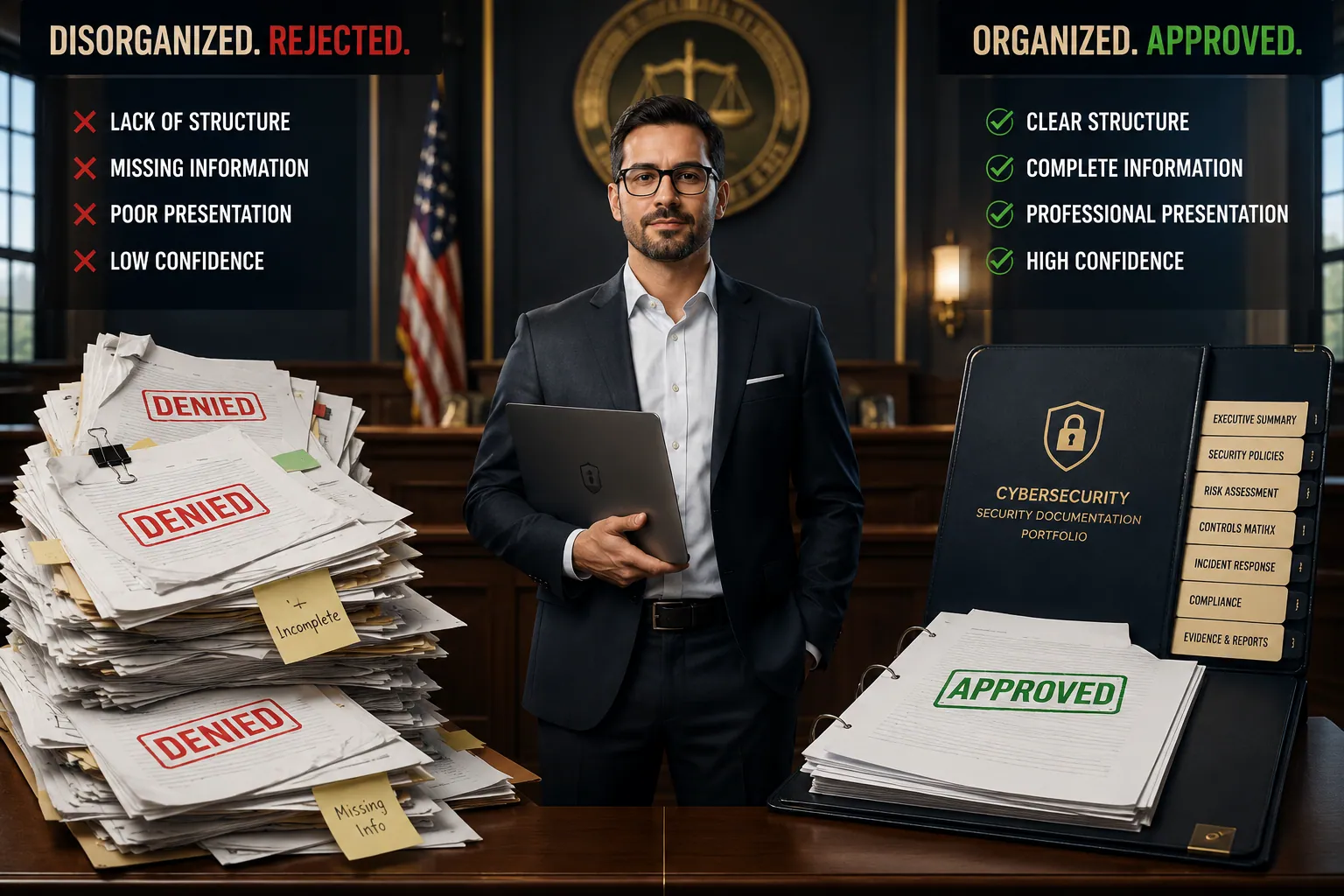
Don’t apply for your EB1A yet.
Not until you’ve read this.
Because the single most expensive mistake cybersecurity professionals make isn’t submitting too little evidence — it’s submitting the wrong kind, in the wrong frame, with the wrong explanation. USCIS denies the petition. You assume you didn’t qualify. You walk away.
That assumption has cost hundreds of genuinely extraordinary professionals their shot at a U.S. green card.
Here’s what actually happened in a real August 2024 AAO case — and what it tells you about building a cybersecurity EB1A petition that holds up under scrutiny.
Why Cybersecurity Professionals Keep Getting Denied (And Why That’s About to Change for You)
Picture this: you’ve spent fifteen years building an expertise that most hiring managers can’t even fully evaluate. You’ve published on Habr, spoken at DEFCON, written threat intelligence reports that shaped company-wide policy at Fortune 500 firms. You know your field. You know you’re good.
USCIS disagrees.
Their officer — likely not a cybersecurity expert — reads your Habr articles and thinks: no footnotes, not a journal, doesn’t count. They look at your Forbes Kazakhstan feature and think: regional outlet, insufficient circulation proof, doesn’t count. They scan your role as a chapter lead for a professional association and think: membership criteria unclear, doesn’t count.
One credit. Out of six claimed. Denial.
This is not a skills problem. This is a framing problem — and framing is fixable.
The Administrative Appeals Office reviewed this exact case and reversed course. They found three qualifying criteria where USCIS found one. The petitioner hadn’t changed his credentials. He changed his documentation strategy.
That distinction matters more than your CV ever will.
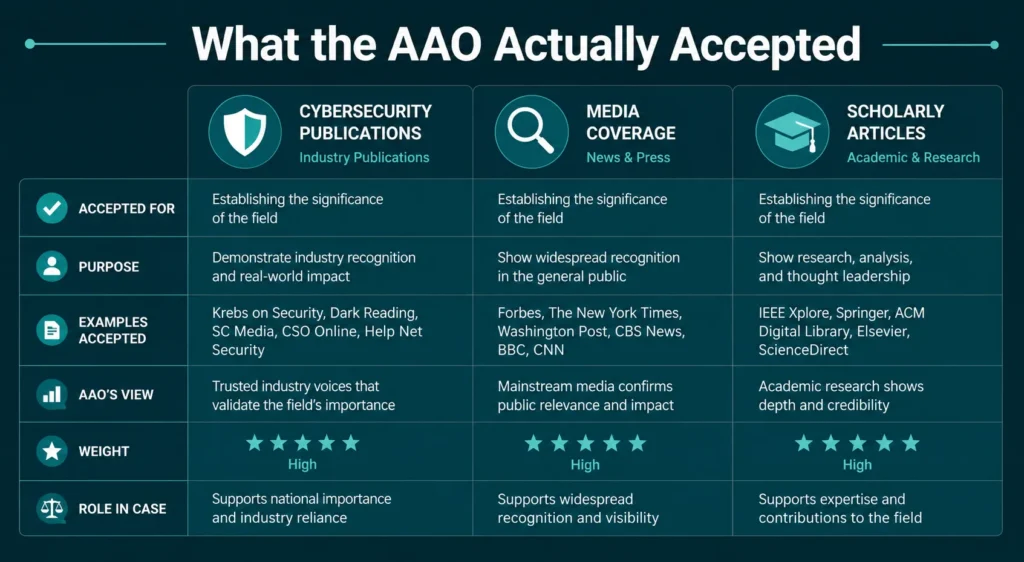
The AAO Evidence Table: What Got Rejected, What Got Accepted, What That Means for You
This is the section worth bookmarking.
The following breakdown maps directly from the August 2024 AAO decision. Three columns. No filler. The third column is where cybersecurity professionals should spend 80% of their preparation time.
Criterion 3 — Original Contributions of Major Significance
| What USCIS Rejected | What AAO Accepted | Your Cybersecurity Application |
|---|---|---|
| General claims of “industry impact” without measurable outcomes | Specific, documented contributions with third-party validation — cited reports, implemented frameworks, traceable policy changes | Threat intelligence frameworks adopted by named organizations; CVE disclosures with verifiable impact scores; security architecture decisions credited in post-incident reviews |
| Letters from colleagues without authority context | Letters from recognized experts who can speak to the field-wide significance of the work | Reference letters from CISOs, SANS instructors, or CVE board members who contextualize why the contribution moved the field |
| Self-reported influence | Citations, adoptions, downstream mentions in other professionals’ published work | GitHub repositories with measurable adoption; published research citing your methodology; vendor advisories crediting your disclosure |
Criterion 4 — Authorship of Scholarly Articles
| What USCIS Rejected | What AAO Accepted | Your Cybersecurity Application |
|---|---|---|
| Articles without academic footnotes or journal affiliation | Expert-facing publications that demonstrate knowledge transmission to a professional audience — regardless of format | Habr.com deep-dives on zero-day exploitation; Kommersant cybersecurity analyses; dark web threat landscape reports published for enterprise security teams |
| Blog posts aimed at general readers | Technical writing requiring domain expertise to interpret, published in platforms where the readership is practitioners | Medium publications with practitioner audiences; published incident response case studies in industry forums; technical advisories distributed through CERT channels |
| Incomplete publication context | Full platform context: readership demographics, editorial standards, audience qualification | Circulation data, editor credentials, reader demographic breakdowns — filed as supporting exhibits |
The clarification that changed everything: AAO explicitly held that “scholarly” in business and technology fields means written for experts in the field — not written for academics. This one sentence is worth reading twice. Your Habr article, your Kommersant op-ed, your ISACA journal contribution — these qualify. USCIS just needs to understand who reads them and why that matters.
Criterion 7 — Display of Work at Exhibitions or Showcases
| What USCIS Rejected | What AAO Accepted | Your Cybersecurity Application |
|---|---|---|
| (This criterion was accepted by both USCIS and AAO) | Conference presentations, published demonstrations, showcased tools or methodologies at recognized events | DEFCON talks, Black Hat presentations, RSA Conference workshops, tool demonstrations at BSides events |
Criterion 5 — Major Media Coverage
| What USCIS Rejected | What AAO Accepted | Your Cybersecurity Application |
|---|---|---|
| Media mentions without circulation or reach data | Articles with documented circulation statistics, full translations where applicable, and clear connection to professional work | Forbes regional editions with circulation documentation; Tech Times features tied to specific contributions; Wired or Ars Technica quotes with publication reach data |
| Partial submissions lacking translated context | Complete submissions: full article, certified translation, outlet description, circulation figures | Every non-English article needs a certified translation plus an exhibit explaining the outlet’s standing in its media market |

The 28-Page Cover Letter: Why Volume Isn’t Vanity
One approved cybersecurity EB1A petition included a 700-plus-page application. The cover letter alone ran 28 pages.
That sounds excessive until you understand what a cover letter actually does in an EB1A petition.
It isn’t a summary. It’s a legal argument.
The cover letter’s job is to walk the USCIS officer — who may have no cybersecurity background — through every piece of evidence, explain why it matters, connect it to the specific regulatory criterion it satisfies, and preemptively answer every objection they might raise.
Think of it as a brief that assumes the reader knows nothing and questions everything.
A 28-page cover letter for a cybersecurity petitioner typically maps across these functional sections:
1. Professional Narrative (2–3 pages): Who you are, why your field matters nationally and internationally, what problem your expertise solves. Written at the level of a smart general reader, not a technical peer.
2. Criterion-by-Criterion Analysis (15–20 pages): One section per claimed criterion. Each section states the legal standard, maps your evidence to it, anticipates the likely objection, and counters it with specifics. This is where most petitioners underinvest.
3. Final Merits Argument (3–5 pages): The holistic case. Why, taken together, your evidence places you in the top tier of your field globally. This section must do more than restate what came before — it must synthesize.
4. Evidence Index (2–3 pages): A cross-referenced table of every exhibit, what criterion it supports, and where to find it in the package.
Here’s the IKEA effect at work: the more deliberate construction you put into this document — mapping each exhibit to each criterion with your own hand — the more compelling it becomes. Not because length signals quality. Because thoroughness signals you understand the standard and have met it consciously.
The Scholarly Work Reframe: Turning Your Industry Writing into EB1A Ammunition
This is the nuance that costs cybersecurity professionals the most approvals.
USCIS officers, by default, pattern-match “scholarly” to academic. Footnotes, peer review, journal affiliation. If your writing doesn’t look like a journal article, they discount it.
The AAO’s 2024 ruling pushes back on that assumption hard.
For technology and business fields, the operative test isn’t format — it’s audience. Did experts in the field read this? Did it transmit specialized knowledge they couldn’t have gotten from a general-audience source? Did it require professional competence to write?
If yes to all three: scholarly.
Now reframe your publication history through that lens.
Your Habr post explaining a novel persistence mechanism in a sophisticated threat actor campaign? Scholarly. Your Kommersant piece on emerging attack vectors in critical infrastructure? Scholarly. Your ISACA contribution on zero-trust implementation failures? Obviously scholarly — and you should have led with it.
The documentation burden is yours. You have to prove the audience is expert. That means:
- Habr readership demographics showing percentage of professional developers and security practitioners
- Kommersant circulation data and editorial positioning as a business-expert outlet
- ISACA membership statistics establishing who reads its publications
One exhibit per claim. Translated where necessary. Referenced in the cover letter’s scholarly articles section with full context.
The pratfall effect is real here: acknowledging that your publications aren’t in Nature or IEEE — and then explaining exactly why they don’t need to be — reads as more credible than pretending the distinction doesn’t exist. Officers notice confidence in the face of an apparent weakness. Use it.
What USCIS Still Gets Wrong About Cybersecurity Credentials
Let’s name the pattern so you can address it directly.
USCIS officers evaluate cybersecurity evidence with frameworks built for academic scientists. They look for:
- Peer-reviewed journals (cybersecurity moves too fast for traditional peer review)
- Prizes with recognizable names (most cybersecurity recognition happens at the practitioner level, not via named awards)
- Membership in organizations with “outstanding” criteria (many elite cybersecurity communities are invitation-based but don’t publish formal membership criteria)
None of these map cleanly onto how the cybersecurity field actually confers prestige.
Your job — and your petition writer’s job — is to build the translation layer. Every piece of cybersecurity evidence needs a bridge document explaining:
- How this type of recognition functions in the cybersecurity field
- Why it is the equivalent of what the criterion describes
- Who else at the top of the field has received it
That third point matters more than most petitioners realize. Comparative evidence — showing that the recognition you received is the same type other acknowledged leaders in cybersecurity have earned — is one of the strongest tools in the final merits determination.
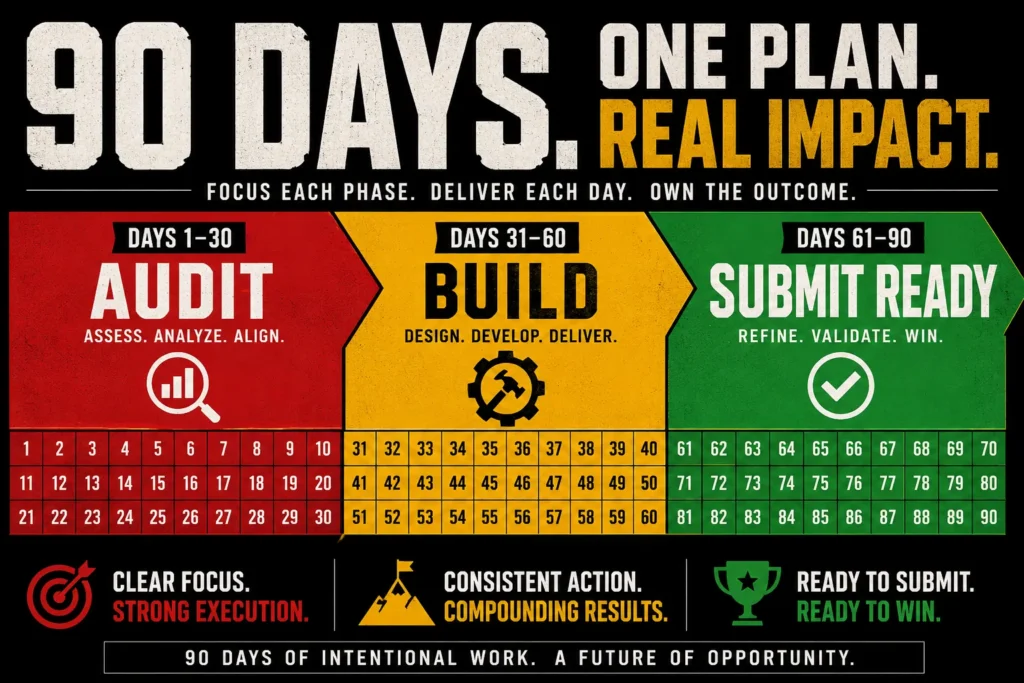
Your 90-Day EB1A Evidence Audit: Start This Week
You don’t need a complete petition to start building a winning one. You need a structured audit of what you already have — and a clear plan for filling the gaps before you file.
Here’s a time-bound framework. Compress or extend based on your filing timeline, but don’t skip phases.
Days 1–30: Audit Everything You Have
Pull every piece of evidence you might use. Don’t filter yet. Just collect.
- All publications (articles, whitepapers, blog posts, advisories, conference papers)
- All media coverage (news mentions, podcast appearances, interview transcripts)
- All leadership roles (association boards, working groups, conference committees, advisory positions)
- All awards and recognition (industry awards, nominations, peer recognition, employer commendations)
- All citation and reference data (who has cited your work, where, in what context)
For each item, note: publication/outlet name, date, audience type, circulation or reach, and any third-party validation of its significance.
At the end of Day 30, map each item against the ten EB1A criteria. You’re looking for three strong clusters — ideally four or five, since USCIS may reject one or two.
Days 31–60: Build What’s Missing
Most cybersecurity professionals are stronger on contributions and media than on formal recognition. If your audit reveals gaps, here’s where to close them fast:
Membership gaps: Apply now for ISACA, (ISC)², CISA, or relevant working groups. Document the selection criteria. Even if membership isn’t finalized by filing, documented application with acceptance criteria on record strengthens the claim.
Scholarly article gaps: Commission or expand an existing technical piece for a practitioner outlet. Habr, SANS Reading Room, DarkReading contributor posts, or an ISACA white paper all qualify — if you document the audience.
Critical role gaps: Identify conference program committees, open-source project governance boards, or professional association chapters where your expertise would qualify you for a formal role. Reach out now. A two-month advisory role with documented responsibilities is better than nothing.
Media gaps: If you have existing expertise worth covering, HARO (now Connectively) and direct journalist outreach can generate legitimate media mentions within 30–60 days.
Days 61–90: Frame, Document, Submit-Ready
Now build the translation layer for every piece of evidence.
For each exhibit:
- Write a one-paragraph context statement explaining its significance in the cybersecurity field
- Attach circulation data, readership demographics, or equivalent reach documentation
- Cross-reference to the specific EB1A criterion it supports
- Identify which reference letter writer can speak to its field-wide significance
Draft your cover letter argument for each criterion. You’re not writing the final version yet — you’re stress-testing whether your evidence actually holds up under scrutiny.
If it doesn’t hold up in a 500-word summary, it won’t hold up in an officer’s review.
The One Question That Predicts Approval
Before you file — or before you appeal a denial — ask yourself this:
If a USCIS officer with no cybersecurity background reads this petition, will they understand not just what I did, but why the cybersecurity field considers it significant?
That gap — between what you know is impressive and what a non-expert can recognize as impressive — is where most petitions fail.
Every exhibit needs a bridge. Every claim needs context. Every criterion needs a legal argument, not just a pile of documents.
The cybersecurity professional in the August 2024 AAO case didn’t win because he added new credentials. He won because he rebuilt the translation layer between his evidence and the standard the AAO applies.
You can do the same.
One More Thing (Before You File Anything)
The final merits determination — the step the AAO sent this case back for — isn’t just about meeting three criteria. It’s a holistic evaluation of whether you’re genuinely among the best in your field globally.
That means your reference letters matter as much as your exhibits.
A reference letter from a recognized CISO who can say, specifically, why your threat intelligence framework changed how their organization operates — and who can contextualize your work against what other top professionals in the field have contributed — carries more weight than ten letters from peers saying you’re talented.
Two or three letters like that, paired with a tightly argued cover letter and clean exhibit documentation, beat a hundred pages of undifferentiated evidence every time.
Want the petition letter framework that maps to the AAO’s exact acceptance criteria — with cybersecurity-specific examples for each of the ten EB1A criteria?
Our writers have built cases for cybersecurity professionals across threat intelligence, application security, cloud architecture, and incident response. We know what USCIS pushes back on, what the AAO accepts, and how to build the translation layer between your credentials and the standard that gets petitions approved.