

The USCIS A-Number is a unique identifier assigned by the Department of Homeland Security to non-citizens, and understanding it is essential for anyone navigating the EB-1 or EB-2 NIW self-petition process.
What is my alien registration number, exactly? According to USCIS, the A-Number — formally called the Alien Registration Number — is a 7, 8, or 9-digit code that functions as your permanent record number within the federal immigration system. Think of it as a Social Security Number, but specifically tied to your immigration history rather than your tax identity.
A common source of confusion is the difference between the Alien Registration Number and the USCIS Online Account Number. These are distinct identifiers. The A-Number is assigned by DHS and follows a non-citizen for life, while the USCIS Online Account Number is a separate, system-generated credential used only to access your online account — it carries no legal immigration weight on its own.
Not every foreign national receives a USCIS A-Number automatically. It is typically assigned to Lawful Permanent Residents, certain visa holders, and applicants for Employment Authorization Documents. In practical terms, what is an immigration registration number? It is the thread that ties every petition, adjustment, and renewal to a single, lifelong record — one that persists regardless of name changes or status transitions.
Knowing precisely where that number appears on your documents is the logical next step, and that is exactly what the following section addresses.
Locating Your A-Number Across Common Immigration Documents
Understanding what an A-Number is in USCIS terms is only half the equation — knowing precisely where to find it on your physical and digital documents is what prevents costly filing errors.
Once you understand that the A-Number functions as a lifelong identifier, the practical challenge becomes locating it across documents that label it inconsistently. On a Permanent Resident Card, the number appears under the label “USCIS#” on the card’s front face. On an Employment Authorization Document (EAD), it similarly surfaces under that same “USCIS#” field. The USCIS immigrant fee payment guidance also confirms that Immigrant Data Summaries and visa handout packets issued at overseas consulates include the A-Number prominently for newly approved immigrants.
One area that confuses many petitioners is the I-797C Notice of Action, where the A-Number may appear near the top alongside a receipt number — and here the distinction matters. What is a receipt number USCIS issues? It is a transaction-specific tracking code (such as LIN- or SRC- prefixed strings) tied to a single filing event, not to the individual. The A-Number, by contrast, follows you indefinitely. Similarly, if you use E-Verify for employment authorization confirmation, you may wonder how E-Verify works with USCIS — that system cross-references your A-Number against DHS records to validate work eligibility. And should you ever need live assistance, knowing the USCIS customer service number (1-800-375-5283) can help you confirm which field on a document corresponds to your A-Number. The upcoming section unpacks these identifier distinctions further.
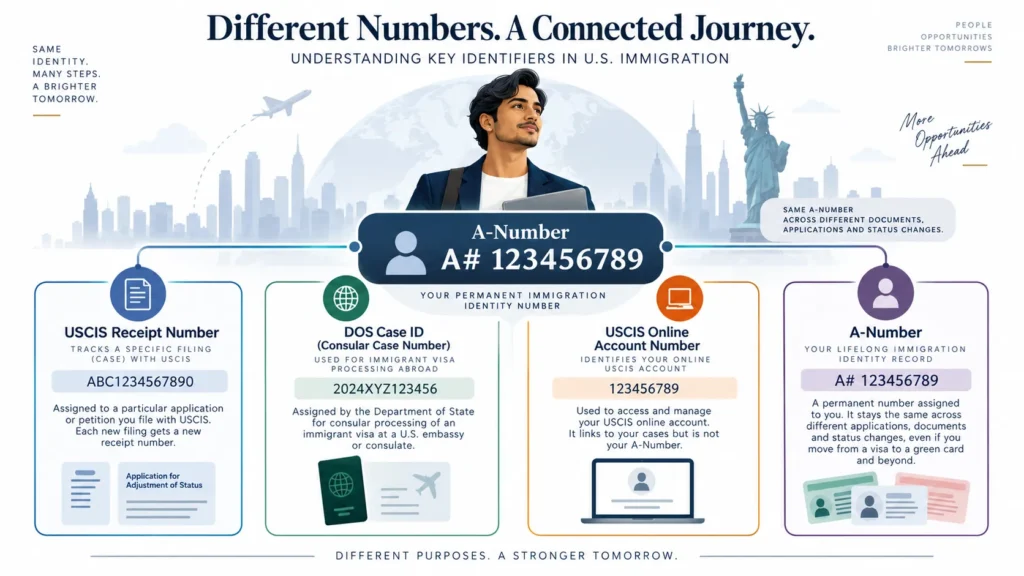
Visual Guide: A-Number vs. Receipt Number and Case ID
Understanding what an A-Number assigned by USCIS is versus the other identifiers on your documents is foundational to avoiding misfiled petitions and processing delays.
Receipt Numbers are transaction-specific codes — prefixed with strings like LIN- or SRC- — that track a single filing event, not the individual behind it. Once USCIS closes that case, the Receipt Number retires. Your A-Number, by contrast, persists for life. And if you have ever wondered what is a USCIS account number versus an A-Number, the distinction matters: an online USCIS account number is a portal-login credential, while the A-Number is your permanent DHS identity thread, recognized across every agency that touches immigration records.
DOS Case ID is another source of confusion. Issued by the Department of State for consular processing, it appears on immigrant visa documentation but differs structurally from the A-Number — the two are linked at fee payment but serve separate bureaucratic functions. If you are asking what the USCIS number on a Green Card is, the answer is the nine-digit A-Number printed on the card’s back, prefixed with “A#” just above the magnetic stripe, distinct from the card’s document number on the front.
| Identifier | Format | Scope | Where Found |
|---|---|---|---|
| A-Number | A + 9 digits | Lifetime / person-specific | Green Card, EAD, approval notices |
| Receipt Number | LIN/SRC/EAC + 13 chars | Single filing | Form I-797 notice |
| DOS Case ID | NVC-assigned alpha-numeric | Consular case | Immigrant visa packet |
| USCIS Account Number | Portal-assigned numeric | Online account only | USCIS.gov dashboard |
For urgent clarification, what is USCIS customer service number? It is 1-800-375-5283 — useful when a document lists an unfamiliar identifier and you need confirmation of which field applies to your petition. That clarity becomes especially consequential for high-achievement filers, which the next section examines in depth.
Technical Deep Dive: The A-Number in High-Achievement Petitions
What is the A-Number in the context of EB-1A and EB-2 NIW self-petitions? It is the identifier that anchors every piece of your professional and immigration history to a single, permanent federal record.
Understanding what is the A-Number matters especially for high-achievement filers, because Form I-140 — the immigrant petition that drives both the EB-1A extraordinary ability and EB-2 National Interest Waiver pathways — contains a dedicated field for it. What many first-time self-petitioners do not realize is that this field may be left blank if USCIS has never previously assigned them a number. In practice, applicants who arrive on an F-1 or J-1 visa and have never held a green card, an Employment Authorization Document, or undergone removal proceedings will typically have no A-Number yet. Submitting a blank field in that scenario is entirely appropriate and will not trigger a Request for Evidence.
The A-Number as a Professional Record Anchor
What is alien registration number on green card if not the connective tissue between your past filings and your future status? For EB-1A and EB-2 NIW petitioners who do already hold an A-Number — perhaps from a prior OPT-based Employment Authorization Document — USCIS guidance confirms that the same number carries forward indefinitely, linking prior OPT authorization, any interim status changes, and the I-140 petition into one cohesive record. And understanding what is alien registration number USCIS number in this longitudinal sense helps explain why inconsistencies across filings — such as a transposed digit — can surface years later as a processing complication.
The STEM OPT online application presents a nuanced sub-scenario. Applicants in that pathway who have already received an EAD will possess an A-Number and must include it accurately on all subsequent filings. What is USCIS number mean in this context? It means that your identifier has already been activated, and omitting or misstating it on a later I-140 creates a record mismatch that can delay adjudication. The following section addresses what happens when that record is fragmented — through duplicate assignments or missing numbers entirely.
- First-time I-140 filers with no prior EAD or status: Leave the A-Number field blank; USCIS will assign one upon approval.
- Filers with a prior EAD or OPT authorization: Locate and include the existing A-Number exactly as it appears on that document.
- STEM OPT applicants filing a subsequent I-140: The A-Number from the OPT EAD must be carried forward to maintain a consistent record.
- Petitioners with prior removal or adjustment history: An A-Number was almost certainly assigned; verify it before submission to avoid a mismatch.
Common Failure Modes: Handling Missing or Multiple A-Numbers
What is a USCIS A-Number situation that derails more petitions than almost any other administrative error? Having two conflicting A-Numbers on record — or none at all when a form demands one.
Duplicate A-Numbers arise more often than the system’s designers intended. In practice, USCIS may inadvertently issue a second A-Number when a filer’s earlier record is not located during processing — a scenario that occurs frequently with applicants who changed names, used a transliteration variant, or entered through different ports of entry years apart. If you discover you hold two distinct numbers, the standard resolution is to contact the USCIS Contact Center and request a record consolidation. A Freedom of Information Act (FOIA) request submitted directly to the agency can surface the full history of both numbers, clarifying which one your official Alien File reflects. Understanding what is a USCIS alien number on each record is essential before initiating that consolidation request, because submitting petitions under the wrong number compounds the error rather than correcting it.
Missing A-Numbers present a separate challenge. When a document lacks an A-Number but a new filing requires one — a common scenario for first-time I-140 petitioners transitioning from F-1 OPT — the correct approach is to leave the field blank and allow USCIS to assign the number upon approval, rather than entering an estimated or recycled identifier. Filers sometimes conflate the receipt number (what case number is USCIS processing at a given moment) with the A-Number; those are categorically different identifiers, and substituting one for the other triggers a Request for Evidence.
And what about naturalized citizens? After naturalization, the A-Number does not simply disappear from relevance. Certain federal benefit applications, background check processes, and historical record requests may still reference it. However, a naturalized citizen does not use the A-Number for active immigration filings, since citizenship replaces the underlying non-immigrant or immigrant status it was tied to. One practical analogy: consider what happens next after H-1B lottery selection, where an approved worker carries their A-Number forward through every subsequent status change — naturalization is simply the terminal point of that chain. Verifying your number through a FOIA request before naturalization finalizes ensures your Alien File is complete and accurate for any future reference.
Strategic Application: Using Your A-Number on Form I-9 and I-765
Knowing what is the A-Number for USCIS purposes on employment verification forms is where administrative precision directly affects your legal work authorization.
Form I-9, Section 1 requires non-citizens to enter their A-Number accurately. The most common formatting error here is an 8-digit number entered without a leading zero — USCIS requires a 9-digit standard, so an 8-digit A-Number must be padded (example: A12345678 becomes A012345678). That single missing digit can trigger a Tentative Non-confirmation (TNC) during E-Verify, stalling your employment before a single day of work begins. And if you are wondering what does USCIS number stand for in this context, it is the Alien Registration Number — the permanent federal identifier that E-Verify cross-references against DHS records to confirm eligibility.
International researchers and software engineers on O-1 or H-1B status face an additional layer of complexity. If you have previously held OPT or an EAD, your existing A-Number must appear on both the I-9 and any subsequent Form I-765 filing — inconsistency between the two creates record mismatches that can delay adjudication. If you are uncertain what USCIS office is processing your case during this period, the USCIS online case status portal provides the assigned processing location. A related practical note: if USCIS needs to reach you regarding a TNC or documentation issue, knowing what number does USCIS call from (typically displayed as an 802 area code) helps you distinguish legitimate agency contact from third-party inquiries. These operational realities around the A-Number connect naturally to a broader question — what the number can and cannot confirm about your immigration status, which the following section addresses directly.
Trust and Reliability: Limitations of the Alien Registration Number
Possessing an A-Number confirms federal tracking of your immigration record — it does not confirm legal permanent status, work authorization, or any specific immigration benefit.
This distinction matters enormously in practice. What does alien registration number mean, precisely? It means USCIS has opened an Alien File in your name. Full stop. The number itself conveys no status; the underlying petition or approval that prompted its assignment does. A person with a pending removal order carries an A-Number just as a lawful permanent resident does. And many visitors — including B-1/B-2 tourists and short-stay business travelers — may never receive one at all, because temporary nonimmigrant entries of that category do not automatically trigger assignment.
The A-Number is also not a Social Security Number. The two identifiers serve entirely different federal systems: the SSN tracks tax and benefits history through the Social Security Administration, while the A-Number tracks immigration history through DHS. Confusing them on forms such as Form I-539 — where what is a number in I-539 form refers specifically to the Alien Registration Number, not the SSN — is a common error that can delay adjudication. Similarly, what is a USCIS online account number is a separate, portal-specific credential tied to your myUSCIS login, distinct from both.
Because the A-Number links directly to your complete Alien File, treat it as sensitive personally identifiable information. Share it only with authorized legal representatives, employers conducting lawful I-9 verification, or federal agencies with a documented need. These operational boundaries set the stage for the practical questions self-petitioners ask most often — addressed directly in the next section.
Frequently Asked Questions for Self-Petitioners
The three questions self-petitioners ask most often about the A-Number each have a precise, document-grounded answer — and confusing any one of them can delay an otherwise complete petition.
Where is my A-Number? For the vast majority of filers, the answer lies in one of three documents: your Permanent Resident Card (Green Card), your Employment Authorization Document, or a prior Notice of Action (Form I-797). If you are asking specifically what is the alien number on a green card, it appears on the card’s front face, labeled “USCIS#” — the “A” prefix is implied.
A-Number vs. USCIS Account Number. These identifiers serve entirely different functions. What is my USCIS account refers to a portal-specific credential tied to your myUSCIS login — it is a session identifier, not a lifelong record number. The A-Number, by contrast, is a permanent DHS-assigned identifier that follows you across every petition and status change.
Terminology overlap between “Alien Registration Number” and “USCIS Number” reflects a terminology update, not a new credential — both phrases reference the same nine-digit identifier. And what is an immigrant visa case number is a separate DOS-issued reference for consular processing, unrelated to the A-Number entirely. Naturalized citizens generally do not need to include their A-Number on new filings, though retaining it for historical record accuracy remains advisable. Knowing where credible definitions originate — agency glossaries, government documentation, and authoritative legal references — is the foundation the next section examines directly.
Where to Look Next: How to Find Credible Identification Resources
When you ask “what is my A-Number USCIS assigned to me,” the most reliable answer always begins with official agency documentation — not third-party summaries.
The USCIS glossary is the logical first stop. It provides precise, agency-authored definitions for terms that frequently cause confusion among self-petitioners. Related identifiers that generate their own search volume — such as what is online access code USCIS uses for myUSCIS portal authentication, or what is OMB number USCIS includes on form headers to signal federal approval — each have distinct glossary entries or form instructions worth consulting separately. Conflating these identifiers with the A-Number is a pattern that produces avoidable filing errors.
Beyond the glossary, government documentation for specific immigration documents — the Green Card, the EAD, Form I-797 — describes the physical placement and security features of each identifier field. Academic immigration law texts provide valuable historical context for how the registration number evolved as a tracking mechanism. And for employment eligibility purposes specifically, the Form I-9 guidance published by USCIS addresses field-level instruction that glossary definitions alone do not capture. These layered resources, read in sequence, give any self-petitioner a complete, authoritative picture — which the key takeaways ahead consolidate into a practical reference.

What You Need to Know (Key Takeaways)
The answer to “what is my alien number” is precise: a permanent, government-issued identifier of seven to nine digits that the Department of Homeland Security assigns to track your complete immigration record across every interaction with federal agencies.
That single number, confirmed by the USCIS glossary, surfaces most reliably on Green Cards, Employment Authorization Documents, and I-797 approval notices. And it is categorically distinct from your Receipt Number, your USCIS Online Account Number, and any consular case reference — confusing them remains one of the most common administrative errors in self-petitioned filings. For EB-1 and EB-2 NIW applicants specifically, the governing rule is equally clear: provide the A-Number only when one has already been assigned through a prior immigration benefit. If none exists, leave the field blank. Should you need live confirmation of any identifier on your documents, the phone number for USCIS customer service is 1-800-375-5283. And if you are attending an in-person appointment, be aware that what a PIN for a USCIS appointment is is a separate, appointment-specific credential your notice will supply — unrelated to the A-Number entirely. Treat your A-Number as sensitive personally identifiable information, verify it against source documents before every filing, and consult the USCIS immigrant fee payment tips whenever document placement is unclear.